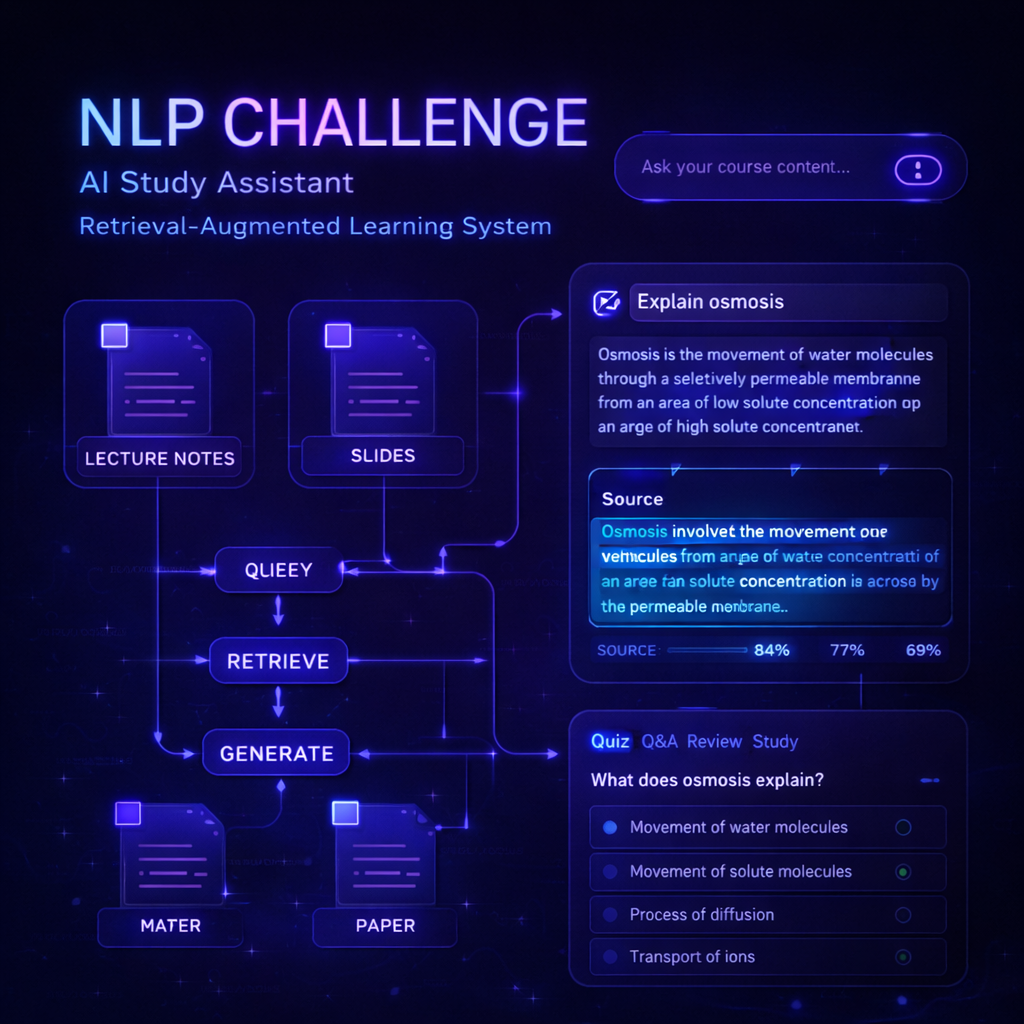
An AI-powered study assistant that helps users interact with course materials in a smarter way. The system processes uploaded academic documents, retrieves the most relevant content, and generates grounded explanations, summaries, and quiz-style learning support.
The goal of this project was to build a reliable academic assistant that could answer questions directly from uploaded course content instead of relying on generic chatbot responses.
The project focused on improving study efficiency by allowing users to query learning materials in natural language and receive responses grounded in real documents.
We approached this by building a Retrieval-Augmented Generation pipeline. Uploaded documents were parsed, chunked, and stored for retrieval. When a user asked a question, the system searched for the most relevant chunks before generating a response. To make the workflow more structured, we used LangGraph to model the application as a single agent with multiple steps for ingestion, retrieval, and answer generation.
2025
AI-powered academic assistant
Grounded answers from uploaded course materials
Group project by a team of 3. We worked on the ingestion, retrieval, generation flow, and testing together.
VS Code, GitHub, FastAPI backend tooling
Supports PDF, PPTX, and DOCX files, converting them into searchable chunks for efficient retrieval.
Retrieves relevant content first, then generates more accurate and course-aware answers.
Generates explanations, short summaries, and quiz-style questions for revision and active learning.
LangGraph manages ingestion, retrieval, and generation as a modular structured workflow.
Explored document ingestion, semantic search, and retrieval-based AI to define the architecture.
Built the backend with FastAPI, Redis-based retrieval, and LangGraph workflow orchestration.
Improved chunking, retrieval relevance, and response flow to make answers more grounded.
Delivered a working AI study assistant and deepened understanding of reliable AI application design.
Traditional study materials are static and difficult to search efficiently. Students often spend too much time browsing slides or notes manually, and general-purpose AI tools may hallucinate or provide answers that are not grounded in course content.
The challenge was to create a system that could understand user questions, retrieve the right content from uploaded materials, and return answers that were accurate, relevant, and useful for learning.
We approached this by building a Retrieval-Augmented Generation pipeline. Uploaded documents were parsed, chunked, and stored for retrieval. When a user asked a question, the system searched for the most relevant chunks before generating a response.
To make the workflow more structured, we used LangGraph to model the application as a single agent with multiple steps for ingestion, retrieval, and answer generation.
"This project showed me that building useful AI systems is not just about using a model. The real value comes from designing the full pipeline around retrieval, structure, and reliability."
NLP + Backend Engineering
"Working on this project improved my understanding of document processing, semantic retrieval, and how agent-based workflows can make AI applications more maintainable and scalable."
RAG + LangGraph + Redis